



Buchner Flask and Buchner Funnel: What They Are and How They Are Used in Vacuum Filtration

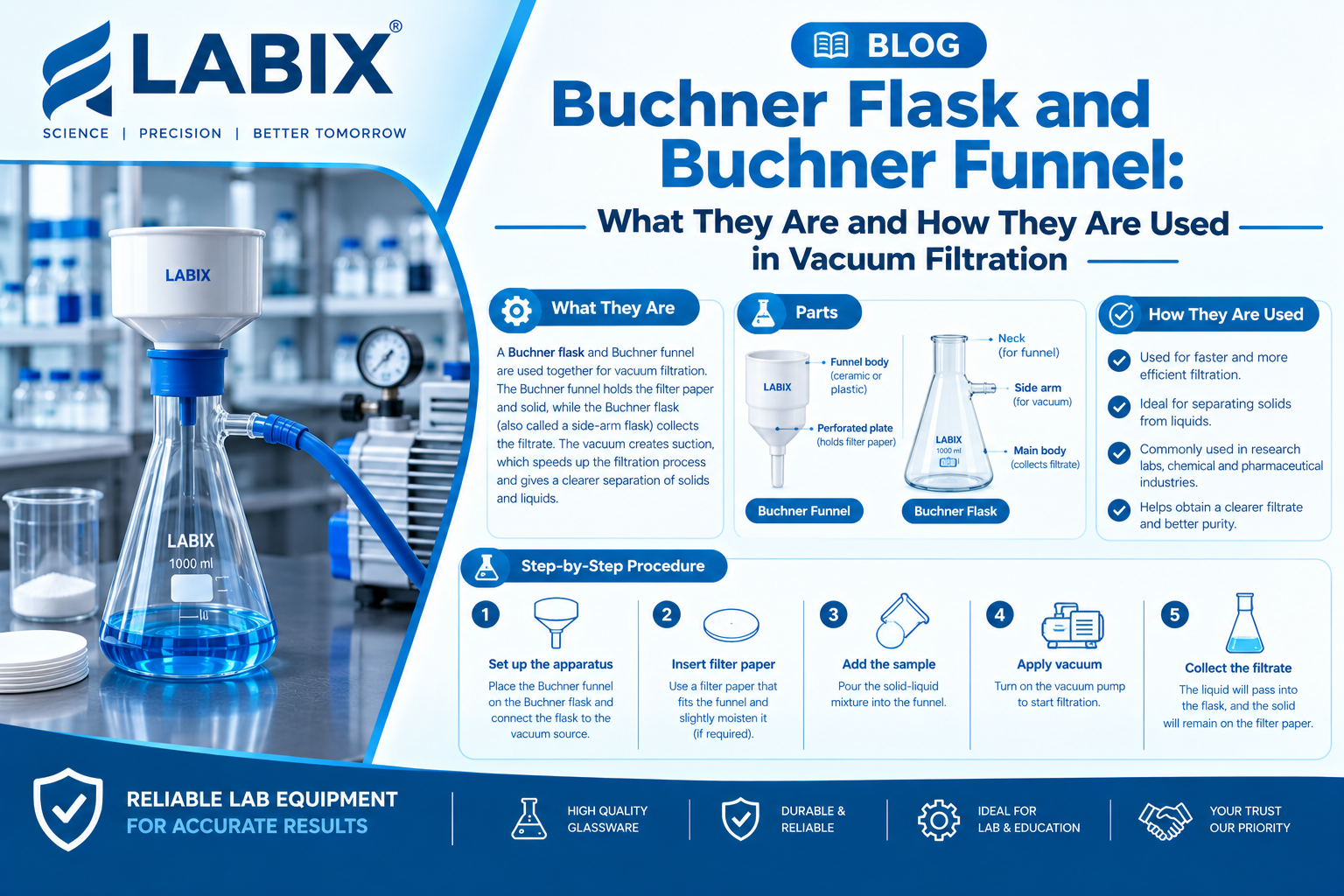
n ordinary conical flask, because the flask has to withstand reduced pressure inside it. During filtration, the flask holds the filtrate. It can also be used as a trap or reservoir in a vacuum line. A wide range of laboratory flasks is available in different capacities, so the right size depends on the volume of liquid you expect to collect.
Chemists use a Buchner flask and Buchner funnel together to separate a solid from a liquid under vacuum.
The Buchner funnel holds the filter paper and the solid, while the Buchner flask, a thick-walled conical flask with a side arm, collects the liquid (called the filtrate) as suction pulls it through. Compared with gravity filtration, this setup is usually faster and leaves the solid drier, which is why it is a routine part of synthesis, quality control and teaching laboratories. In this guide, you will learn what each part does, how vacuum filtration works step by step, where people use the apparatus, how to choose the right materials and sizes, and how to handle vacuum glassware safely.
What Are a Buchner Flask and a Buchner Funnel?
Together, the Buchner flask and Buchner funnel form a simple vacuum filtration assembly. The funnel sits on top of the flask, a rubber adapter makes an airtight seal between them, and you connect a vacuum source to the side arm of the flask. Chemists named the funnel after the German chemist Ernst Büchner, so you will see people write the name both as “Buchner” and “Büchner”. Both spellings refer to the same apparatus.
Buchner Flask (Filter Flask)
People also know a Buchner flask as a filter flask, vacuum flask or side-arm flask. It has a conical body, a narrow neck, and a short tube (the side arm) on the neck, where you attach the vacuum hose.The walls are thicker than those of a
A Buchner funnel has a flat, perforated plate inside a cylindrical or conical body. A circular piece of filter paper rests on this plate and holds back the solid (the residue) while the liquid passes through the holes into the flask below. Manufacturers commonly make Buchner funnels from porcelain, and they also offer versions in glass and plastic. Chemists usually describe the funnel size by the diameter of its plate, which decides how much solid the funnel can handle and which filter paper size fits.
How Vacuum Filtration Works with a Buchner Flask and Funnel
In vacuum filtration, the vacuum reduces the air pressure below the filter paper. The higher pressure above the paper then pushes the liquid through the paper much more quickly than gravity alone would. Because the vacuum also draws air through the solid, the solid cake is usually drier at the end, which helps when you need to wash and dry crystals or collect a precipitate.
Basic Setup Steps
1. Fit the Buchner funnel into the neck of the Buchner flask using a rubber adapter or filtering cone, so the seal is airtight.
2. Connect the side arm of the flask to your vacuum source, such as a water aspirator or a vacuum pump, using thick-walled vacuum tubing.
3. Place a filter paper flat on the funnel plate. It should be slightly smaller than the inside diameter of the funnel but large enough to cover all the holes.
4. Wet the filter paper with a little of the solvent you are using, and switch on the vacuum so the paper seals against the plate.
5. Pour the mixture onto the paper. Let the liquid pass through, and wash the solid with a small amount of cold solvent if your procedure requires it.
6. Disconnect the vacuum hose from the flask or release the vacuum first, and only then switch off the vacuum source. This avoids liquid being drawn back into the system.
Always follow your laboratory’s standard operating procedure and the instructions given by the glassware manufacturer.
Why Vacuum Filtration Is Faster Than Gravity Filtration
In gravity filtration, the liquid moves only because of its own weight, which can be very slow for fine solids that clog the paper. Vacuum filtration adds a pressure difference across the paper, so the pressure difference draws the liquid through faster, and it pulls the solid into a firmer, drier cake. This makes it a good choice for fine crystals and precipitates. Gravity filtration still has its place, for example when you need to keep the solid wet or when the liquid is the only part you want to keep and the volume is small.
Buchner Flask Uses and Buchner Funnel Uses in the Laboratory
The Buchner flask and funnel are among the most common pieces of filtration glassware in chemistry, pharmaceutical and educational laboratories. Below are the main applications.
Common Uses of a Buchner Flask
The main use of a Buchner flask is to collect the filtrate during vacuum filtration. The manufacturer designed its thick walls and side arm for this job. You can also place a filter flask in a vacuum line as a trap, which collects liquid before it reaches the pump, and as a small reservoir to hold liquid under reduced pressure. When you use a flask this way, you should always choose a vacuum-rated filter flask and never an ordinary thin-walled flask.
Common Uses of a Buchner Funnel
A Buchner funnel is used to:
• Isolate crystals after recrystallization
• Collect precipitates formed during chemical synthesis
• Separate solids from liquids in teaching laboratory experiments
• Filter solids in quality control and pharmaceutical workflows, where a quick, repeatable separation is needed
Typical Applications by Setting
In educational laboratories, instructors often use the apparatus for simple demonstrations of recrystallization and filtration. In research laboratories, chemists use it to collect products from reactions. In pharmaceutical and chemical laboratories, it supports routine separation steps, where the laboratory’s own procedures define the exact method.
Materials, Sizes and Compatibility: What to Check Before Buying
Choosing the right Buchner flask and Buchner funnel is mostly about matching the parts to each other and to your chemicals. These are the main points to check.
Flask material and construction.Manufacturers make most filter flasks from borosilicate glass, which laboratories widely use for its chemical resistance and its ability to handle temperature changes. Check that the manufacturer designed the flask for vacuum use, look at the wall thickness, and confirm that the side arm suits the tubing you plan to use.
Funnel material.Glass funnels let you see the solid and the filtering action. Plastic funnels can be lighter, but you should check their chemical and temperature limits carefully.
Always consult the manufacturer’s documentation for the exact limits of a specific product.
Size matching. The funnel must fit the neck of the flask through a suitable rubber adapter, and the filter paper must match the funnel plate diameter. A funnel that is too large or too small for the flask neck will not seal properly.
Capacity. Choose a flask large enough to hold all the filtrate you expect, with some space left over, so liquid never reaches the side arm.
Chemical and temperature compatibility. Make sure the glass, funnel, rubber adapter and tubing are all compatible with the solvents and temperatures in your work.
Buchner Funnel vs Hirsch Funnel vs Sintered Glass Funnel
These three funnels are used for similar tasks, but they are not identical.
Buchner funnel: has a larger flat plate and uses a separate filter paper. It is the usual choice for general vacuum filtration of moderate quantities.
Hirsch funnel: looks similar but is smaller, with sloped sides. It is suited to small quantities of solid, where a large plate would spread the solid too thinly.
Sintered (fritted) glass funnel: has a porous glass disc built into it, so it does not need filter paper. These funnels come in different porosity grades, and the grade should be chosen to suit the particle size being filtered.
Safety, Cleaning and Common Mistakes
Vacuum glassware stores stress when it is under reduced pressure, so careful handling matters.
Safety Precautions for Vacuum Glassware
• Use only flasks that are designed for vacuum work. Do not use thin-walled or flat-bottomed flasks under vacuum.
• Check the flask and funnel for cracks, chips and star-shaped cracks before every use. Damaged glassware should be taken out of use.
• Fit a trap between the flask and the pump when working with volatile or corrosive liquids, to protect the pump.
• Wear suitable personal protective equipment, and follow your laboratory’s safety procedures and the manufacturer’s instructions for each product.
Cleaning and Maintenance
Rinse the flask and funnel soon after use, so residues do not dry and harden. Avoid abrasive tools that can scratch glass or damage a porcelain surface. Check the rubber adapter regularly, because a worn or cracked adapter will leak and make it harder to hold a vacuum.
Common Mistakes to Avoid
• Using filter paper that is too large, so it folds up the sides and lets solid pass around the edge
• Not wetting the paper before starting the vacuum, which can leave gaps under the paper
• Poor sealing between the funnel and the flask
• Switching off the vacuum source before releasing the vacuum in the flask
• Continuing to use glassware that is cracked or chipped
Frequently Asked Questions
What is the difference between a Buchner flask and a Buchner funnel?
A Buchner flask is the thick-walled conical flask with a side arm that collects the filtrate. A Buchner funnel is the flat-plate funnel that holds the filter paper and the solid. They are designed to be used together in one vacuum filtration setup.
Can I use a normal conical flask instead of a Buchner flask for vacuum filtration?
No. A standard thin-walled flask is not designed to withstand reduced pressure and could break or implode. Always use a thick-walled filter flask made for vacuum work, and follow the manufacturer’s guidance.
What size filter paper should I use with a Buchner funnel?
The paper should be slightly smaller than the inside diameter of the funnel plate, while still covering all the holes. Wet it before filtering so it lies flat. Choose the paper grade according to the particle size of the solid you want to collect.
Which is better, a porcelain or a glass Buchner funnel?
It depends on your application. Glass lets you see the solid and the filtering action, while porcelain is a common general-purpose choice. Compare visibility, chemical resistance, cleaning needs and cost, and check the manufacturer’s information for your chemicals.
Why is my Buchner funnel not creating a good vacuum seal?
Check that the rubber adapter fits both the funnel and the flask neck, that the tubing is firmly attached, and that the filter paper is flat and wet. Also look for cracks in the glassware or loose connections along the vacuum line.
Conclusion
A Buchner flask and Buchner funnel make solid-liquid separation faster and cleaner. The flask collects the filtrate, the funnel holds the solid, and the vacuum does the work of drawing the liquid through. For reliable results, match the funnel, adapter and flask sizes, choose materials that suit your chemicals, and inspect vacuum glassware before every use. LABIX Labware is a manufacturer and exporter of scientific laboratory glassware, labware and laboratory equipment. You can explore our laboratory glassware range, or send us an enquiry with your requirements.
