
What Is a Condenser? Liebig, Graham, Allihn, and Dimroth Types Explained

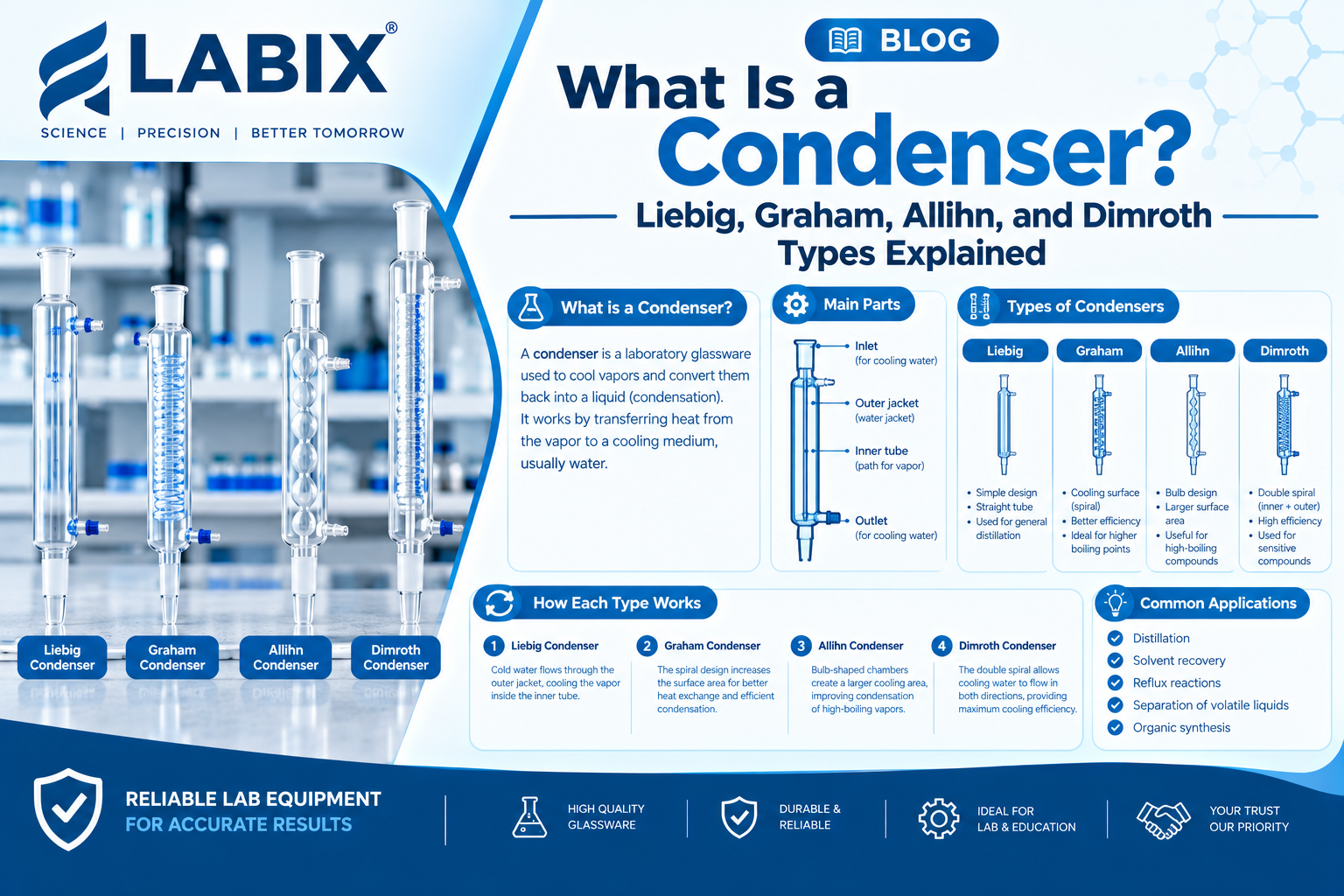
What is a condenser? In a laboratory, a condenser is a piece of glassware that cools hot vapour and turns it back into liquid, usually by passing cold water around or through the vapour path. Condensers keep solvents from escaping during distillation and reflux, and the design you choose affects how efficiently the vapour is cooled. This guide explains what a laboratory condenser is, how it works, and how the Liebig, Allihn, Graham and Dimroth types differ. It also compares distillation and reflux use, and covers what to check before choosing or setting up a condenser. Together, these points cover the main types of laboratory condensers that students and technicians meet.
What Is a Condenser in a Laboratory?
A laboratory condenser works as a heat exchanger. Hot vapour enters one side, gives up heat to a coolant on the other side of a glass wall, and returns to the liquid state. The coolant is usually tap or chilled water, although some designs rely on air alone.
Two jobs account for most condenser use. In distillation, the condenser directs the condensed liquid into a separate receiver, helping separate liquids based on their boiling points. In reflux, the condensed liquid flows back into the reaction flask, allowing the mixture to heat for extended periods with minimal solvent loss.
Manufacturers usually make condensers from glass and fit them with standard taper joints to connect them to flasks and other laboratory glassware. Surface area is the main design variable: more contact between the vapour and the cooled surface generally means more cooling capacity.
Types of Laboratory Condensers Explained
The main types of laboratory condensers differ in the shape of the vapour path and in how the coolant flows. The four main types appear below, followed by other designs and a quick comparison.
Liebig Condenser
The Liebig condenser is the simplest and most familiar design. A straight inner tube carries the vapour, and a surrounding glass jacket carries cooling water. Its simple design makes it easy to manufacture, clean and widely available, making it a common choice for general distillation.
Its limitation is the relatively small cooling surface, so it has lower cooling capacity than bulbed or coiled designs. For vapours that are hard to condense, or for long reflux runs, another type is often more suitable.
Allihn Condenser
The Allihn condenser is a modification of the Liebig design. Its inner tube has a series of bulbs along its length, which increases the surface area available for cooling. This makes it a common choice for reflux, where the vapour must condense and fall back into the flask. The bulbed shape makes cleaning slightly more involved than a straight tube, so rinse it thoroughly after use.
Graham Condenser
The Graham condenser also uses a water jacket, but the vapour passes through a coiled inner tube. The coil gives a much longer path, and therefore a larger cooling surface, than a straight tube. One point to note: Some references indicate that liquid can remain trapped in the coils, so confirm with the supplier whether the condenser is suitable for distillation. Catalogue names also vary, so read the product description and specification table before ordering. LABIX Labware lists Graham jacket distillate type coil condensers among its distillation assemblies.
Dimroth Condenser
The Dimroth condenser reverses the Liebig arrangement. Cooling water circulates through an internal coil, while the vapour passes through the outer jacket space around it. Both coolant connections are usually at the top. The coil provides a large cooling surface in a compact space, making Dimroth condensers ideal for reflux applications that require efficient cooling.
Catalogues sometimes use the term “coil condenser” loosely, so check whether the coolant flows through the coil (Dimroth) or the vapour does (Graham).
Other Common Condensers
An air condenser has no water jacket. Air around the tube cools the vapour, making this design suitable for higher-boiling liquids but less effective for volatile solvents. LABIX Labware air condensers come with socket and cone sizes such as B 14, B 19 and B 24, and effective lengths from 200 mm to 1000 mm. Davies and jacketed coil condensers are other options for distillation and reflux setups.
Condenser Types at a Glance
The table compares the main designs. Treat it as a general guide and confirm details with the supplier’s specification.
| Type | Design | Coolant path | Typical use | Point to note |
| Liebig | Straight inner tube in a water jacket | Water in the jacket | General distillation | Smaller cooling surface |
| Allihn | Bulbed inner tube in a water jacket | Water in the jacket | Reflux | Bulbs need careful rinsing |
| Graham | Coiled inner tube in a water jacket | Water in the jacket, vapour in the coil | Cooling vapour over a long path | Liquid may be retained in coils; confirm use |
| Dimroth | Internal coil carries the coolant | Water in the coil, vapour in the outer jacket space | Reflux | Name often confused with other coil types |
| Air | Plain tube with no water jacket | Air only | Higher-boiling liquids | Limited cooling capacity |
Distillation vs Reflux: Which Condenser Should You Use?
Choosing between condenser types starts with the process, not the name.
In simple distillation, vapour travels from the boiling flask through the condenser, cools, and turns back into liquid, which collects in a receiver.Is this conversation helpful so far? A straight Liebig condenser is a common choice because the condensate drains freely. In reflux, the condenser sits vertically on the reaction flask, allowing condensed liquid to flow back into the flask. Allihn and Dimroth condensers are ideal for reflux because their designs provide a larger cooling surface for efficient condensation.
These are general guidelines, not fixed rules. The right condenser also depends on the boiling point of the solvent, the heating rate, the scale of the reaction and the method you are following. When in doubt, follow the procedure in your laboratory manual or the standard method.
How to Choose the Right Laboratory Condenser
Match the specification to the task with this checklist:
• Application: distillation, reflux or both.
• Joint size and type: the socket and cone must fit your flask and adapters. Product tables list sizes such as B 19 or B 24.
• Length: a longer jacket gives more cooling contact, so confirm the effective length in the specification table.
• Material and heat resistance: confirm the glass type and its temperature limits with the supplier.
• Coolant connections: make sure the connectors suit your tubing.
• Cleaning access: straight tubes are the easiest to clean, while bulbs and coils need more care.
• Documentation: ask for the datasheet or specification table before ordering.
Compare catalogue numbers and dimensions side by side, since two condensers with the same name can differ in length and joint size.
Setting Up and Caring for a Condenser
Good setup protects both the glass and your results:
• Clamp the condenser securely, keeping it vertical for reflux or at the angle your procedure requires for distillation.
• Connect the tubing firmly. For jacketed condensers such as Liebig and Allihn, feed water in at the lower connection and out at the upper one so the jacket stays full, unless the manufacturer says otherwise.
• Turn the water on before heating and keep the flow steady.
• Never heat a completely closed system. Leave a vent or outlet so pressure cannot build up.
• Inspect the glass for chips and cracks before each use, rinse it after use, and handle it carefully.
Always follow your laboratory’s safety rules and the manufacturer’s instructions.
Frequently Asked Questions
What is the difference between a Liebig and an Allihn condenser?
A Liebig condenser has a straight inner tube, while an Allihn condenser has a bulbed inner tube. The bulbs provide a larger cooling surface, making Allihn condensers ideal for reflux, while Liebig condensers are commonly used for simple distillation.
Which condenser is used for reflux?
Allihn and Dimroth condensers are commonly used for reflux because of their larger cooling surface. The right choice still depends on the solvent, heating rate and method, so check your procedure.
Why does water enter a condenser at the bottom?
In jacketed condensers such as Liebig and Allihn, water entering at the lower connection fills the jacket from the bottom, which keeps the cooling surface covered and avoids air pockets. Follow the manufacturer’s instructions for the specific condenser.
Can a condenser be used without water?
Yes. An air condenser cools vapour with air alone and is generally used with higher-boiling liquids. It has less cooling capacity than water-cooled types, so it is not a substitute for a water-cooled condenser with volatile solvents.
What is a Graham condenser used for?
A Graham condenser has a coiled inner tube inside a water jacket, which gives a longer vapour path and a larger cooling surface. Because condensate can be retained in the coils, confirm its suitability for your process with the supplier’s description.
Conclusion
A condenser turns vapour back into liquid, and the type you pick changes how efficiently that happens. Liebig condensers are ideal for simple distillation, while Allihn and Dimroth condensers are commonly used for reflux. Graham and air condensers serve more specialised applications.Before ordering, confirm the joint size, effective length and intended use in the specification table. If you are building a distillation setup, you can browse the range of distillation assemblies from LABIX Labware, a manufacturer and exporter of laboratory glassware, and send an enquiry for the sizes you need.