
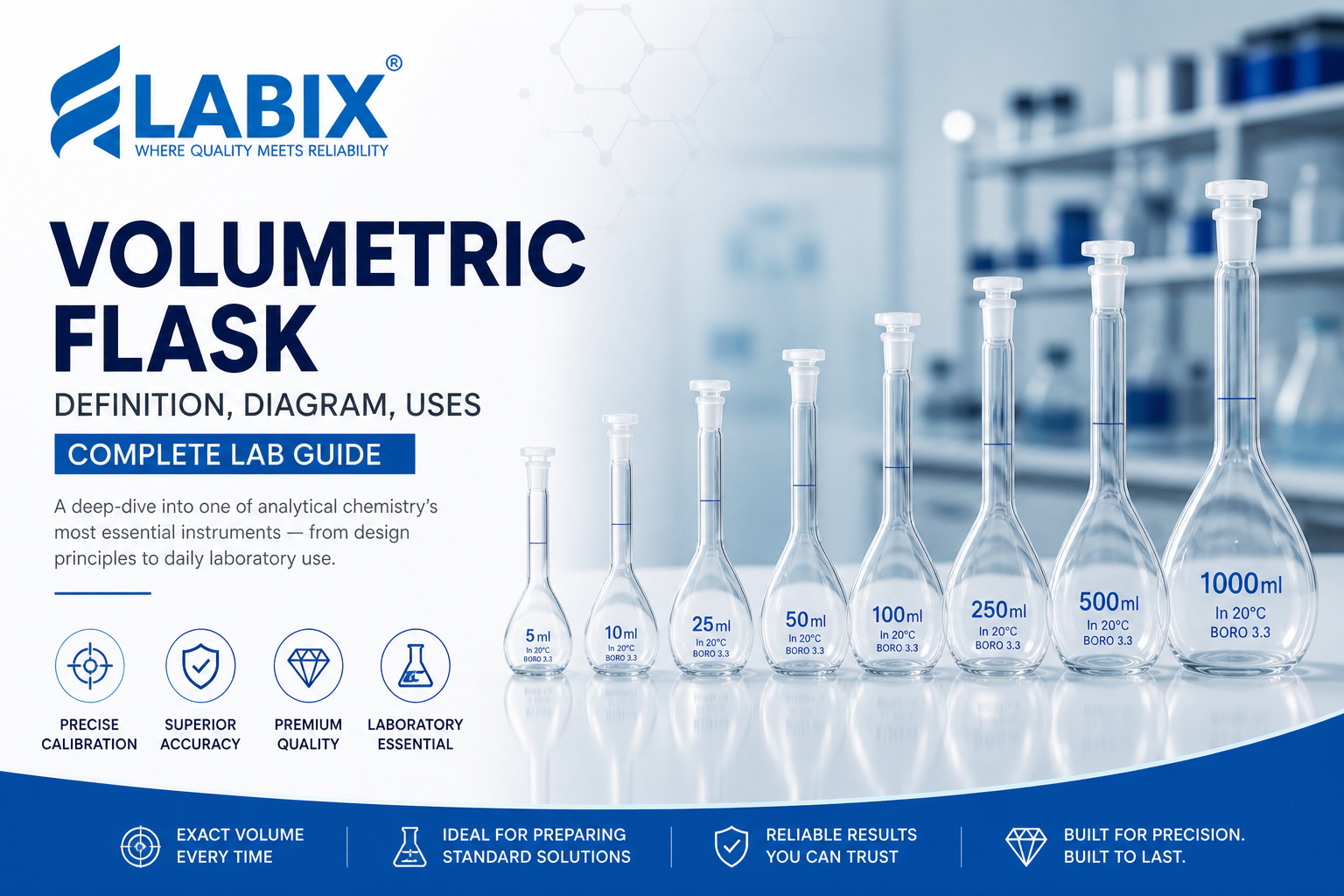
Volumetric Flask: Definition, Diagram, Uses & Complete Lab Guide

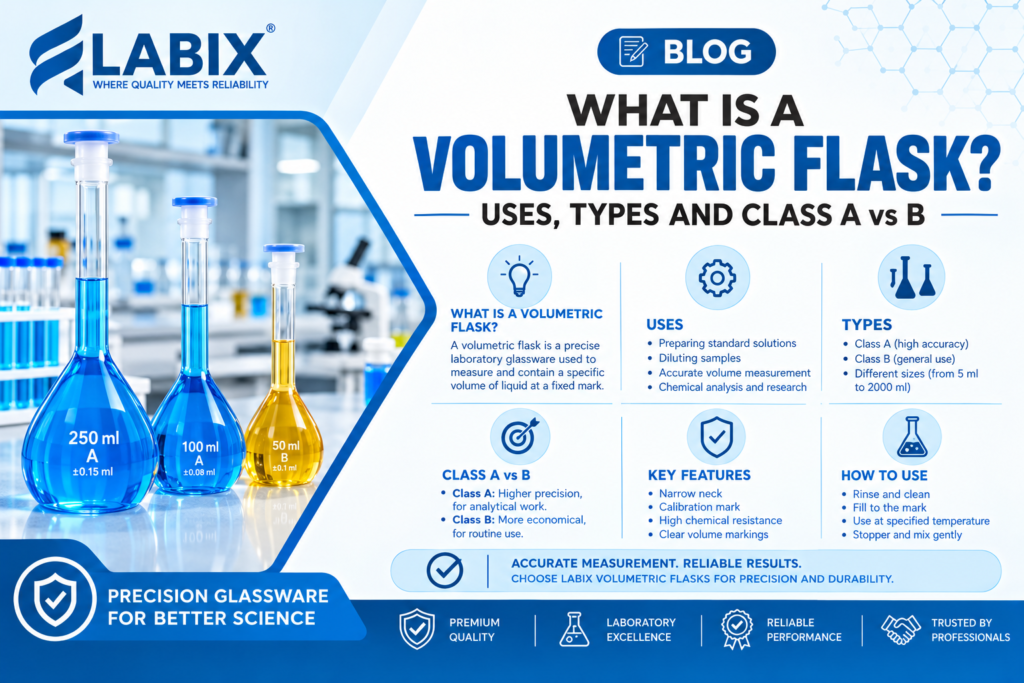
A volumetric flask is an important piece of laboratory glassware used to prepare solutions to a precise and known volume. It is commonly used in chemistry, pharmaceutical laboratories, research facilities, educational laboratories, quality-control laboratories, and analytical testing.
Its distinctive design—a bulb-shaped body, long narrow neck, and single calibration mark—allows laboratory professionals to prepare solutions with greater volumetric accuracy than ordinary beakers or conical flasks.
In this guide, we will explain the volumetric flask definition, parts, diagram, uses, types, advantages, limitations, and correct method of use.
What Is a Volumetric Flask?
A volumetric flask is a calibrated laboratory vessel designed to contain a specific volume of liquid when the liquid level reaches its calibration mark at the specified reference temperature.
Unlike a beaker or Erlenmeyer flask, which is generally used for mixing, holding, or approximate volume measurement, a volumetric flask is specifically designed for accurate preparation of solutions.
Volumetric flasks are generally pear-shaped or bulb-shaped, with a flat base and a long, narrow neck. The neck contains a single graduation or calibration line that indicates the flask’s nominal volume.
Common capacities include 25 mL, 50 mL, 100 mL, 250 mL, 500 mL, and 1000 mL, although other sizes are also available.
Volumetric Flask Diagram and Parts
Understanding the different parts of a volumetric flask makes it easier to use the glassware correctly.
1. Stopper
The stopper closes the flask and helps prevent contamination, evaporation, or accidental spillage during mixing and storage. Depending on the design, volumetric flasks may use glass or plastic stoppers.
2. Narrow Neck
The long, narrow neck provides better control when adjusting the liquid level to the calibration mark. Its narrow diameter also makes small changes in liquid level easier to observe.
3. Calibration Mark
The calibration mark is a single line around the neck of the flask. It indicates the level to which the liquid should be filled to achieve the specified volume under the stated calibration conditions.
4. Bulb or Main Body
The bulb-shaped body provides space for the solution and allows the contents to be mixed by carefully inverting the stoppered flask.
5. Base
The flat base allows the flask to stand securely on a laboratory workbench.
6. Label Area
Many volumetric flasks include a marking area for identifying the solution, concentration, preparation date, or other laboratory information.
What Is a Volumetric Flask Used For?
The primary function of a volumetric flask is accurate preparation of solutions to a known final volume.
1. Preparation of Standard Solutions
One of the most common applications is preparing standard solutions with a known concentration.
A measured amount of solute is transferred into the flask, dissolved in an appropriate solvent, and then diluted carefully to the calibration mark.
2. Dilution of Stock Solutions
Volumetric flasks are widely used when a concentrated stock solution needs to be diluted to a specific concentration.
The dilution relationship is commonly expressed as:
C₁V₁ = C₂V₂
where:
- C₁ = initial concentration
- V₁ = volume of stock solution used
- C₂ = final concentration
- V₂ = final solution volume
The volumetric flask provides the defined final volume required for the calculation.
3. Analytical Chemistry
Accurately prepared solutions are important in many analytical procedures, including titration, spectrophotometry, chromatography, and other laboratory analyses.
4. Pharmaceutical Laboratories
Volumetric flasks are used for preparing analytical solutions, reference solutions, reagents, and samples during laboratory testing and quality-control procedures.
5. Research and Educational Laboratories
Students, researchers, and laboratory technicians use volumetric flasks when experiments require solutions with accurately known concentrations or final volumes.
6. Quality Control and Testing
Laboratories involved in chemical, environmental, food, pharmaceutical, and industrial testing may use volumetric flasks when preparing solutions for analytical procedures.
Types of Volumetric Flasks
Volumetric flasks can be classified according to their capacity, material, and accuracy class.
Volumetric Flask by Capacity
Volumetric flasks are available in a wide range of capacities. Some commonly used sizes include:
| Capacity | Common Application |
|---|---|
| 25 mL | Small-scale solution preparation |
| 50 mL | Analytical and laboratory applications |
| 100 mL | General solution preparation |
| 250 mL | Standard and stock solutions |
| 500 mL | Larger solution preparation |
| 1000 mL | Large-volume solutions |
The appropriate capacity depends on the required final volume of the solution.
Volumetric Flask by Material
Glass Volumetric Flasks
Glass volumetric flasks are widely used in analytical laboratories. Borosilicate glass is commonly selected because of its chemical resistance and suitability for many laboratory applications.
Plastic Volumetric Flasks
Plastic versions may be manufactured from chemical-resistant materials such as polypropylene or other laboratory-grade plastics. They can be useful where reduced breakage risk is important.
The choice of material should depend on the chemical, application, temperature, and required accuracy.
Class A and Class B Volumetric Flasks
Volumetric flasks may also be classified according to their specified accuracy or tolerance.
Class A
Class A volumetric flasks are manufactured to tighter tolerances and are commonly selected for analytical applications where volumetric accuracy is particularly important.
Class B
Class B volumetric flasks generally have wider tolerances and may be suitable for applications where the requirements for volumetric accuracy are less stringent.
Always check the manufacturer’s stated tolerance, applicable standard, and certificate when selecting volumetric glassware for analytical work.
How to Use a Volumetric Flask
Correct technique is important when preparing an accurately measured solution.
Step 1: Add the Solute
Measure the required amount of solute using an appropriate balance and transfer it into the volumetric flask or dissolve it separately before transfer, depending on the procedure.
Step 2: Add Solvent
Add an appropriate amount of solvent to the flask. Do not immediately fill the flask to the calibration line.
Step 3: Dissolve the Solute
Mix carefully until the solute is completely dissolved. If the solution needs to cool before final adjustment, allow it to reach the required temperature according to the laboratory procedure.
Step 4: Bring the Liquid Near the Calibration Mark
Add more solvent until the liquid approaches the calibration line.
Step 5: Adjust the Final Volume
Use a dropper or suitable pipette for the final addition of solvent. Bring the liquid level carefully to the calibration mark.
Step 6: Read the Meniscus Correctly
For liquids with a concave meniscus, read the bottom of the meniscus at eye level and align it with the calibration mark.
Avoid viewing the mark from above or below because this can introduce parallax error.
Step 7: Mix the Solution
Insert the stopper securely and invert the flask several times to ensure the solution is thoroughly mixed.
Step 8: Label the Solution
Clearly label the prepared solution with relevant information such as name, concentration, date, and other details required by the laboratory procedure.
Important Precautions When Using a Volumetric Flask
Follow these practices for reliable results:
- Use the correct flask capacity for the required solution volume.
- Check the flask for cracks, chips, or other damage before use.
- Read the calibration mark at eye level.
- Follow the appropriate meniscus-reading technique.
- Do not use a volumetric flask as a heating vessel.
- Avoid sudden temperature changes with glass flasks.
- Ensure the solute is completely dissolved before making the final volume adjustment.
- Use clean laboratory glassware.
- Follow the manufacturer’s instructions and applicable laboratory standards.
- Do not force a stopper if it is stuck.
Advantages of a Volumetric Flask
Volumetric flasks offer several advantages for laboratory solution preparation:
- Designed for accurate final-volume preparation
- Available in many standard capacities
- Suitable for preparing standard solutions
- Useful for precise dilution procedures
- Narrow neck allows controlled volume adjustment
- Available in glass and laboratory-grade plastic
- Widely used in analytical, pharmaceutical, educational, and research laboratories
Limitations of a Volumetric Flask
Although highly useful, a volumetric flask has some limitations:
- It is designed for a specific nominal volume rather than variable-volume measurement.
- Glass versions can break if dropped or mishandled.
- It should not normally be used for heating.
- Accurate results depend on proper meniscus reading and technique.
- Temperature can affect the volume of liquids and the accuracy of volumetric measurements.
- It is not intended to replace graduated cylinders, pipettes, or other measuring devices for every application.
Volumetric Flask vs Beaker vs Measuring Cylinder
| Laboratory Glassware | Primary Purpose | Volume Accuracy |
|---|---|---|
| Beaker | Mixing, holding and general laboratory work | Approximate |
| Conical Flask | Mixing, reactions and sample handling | Approximate |
| Measuring Cylinder | Measuring different liquid volumes | Moderate |
| Volumetric Flask | Preparing a specified final volume | High |
The choice of laboratory glassware should always depend on the specific procedure and required level of accuracy.
Cleaning and Care of Volumetric Flasks
Proper cleaning and handling can help maintain the condition of laboratory glassware.
Cleaning
Wash the flask using a suitable laboratory cleaning method and rinse thoroughly. Where required by the application, use purified or deionized water for the final rinse.
Inspection
Before use, inspect the flask for:
- Cracks
- Chips
- Scratches
- Damaged calibration marks
- Damaged or unsuitable stoppers
Storage
Store volumetric flasks carefully in a clean, dry location where they are protected from impact and contamination.
Why Is a Volumetric Flask Important in the Laboratory?
Accurate solution preparation is essential for many laboratory procedures. A small error in final volume can affect the calculated concentration and, consequently, analytical results.
The volumetric flask is designed specifically for this purpose. Its calibrated neck, fixed nominal capacity, and controlled shape provide a practical way to prepare solutions to a specified final volume.
For this reason, volumetric flasks remain an essential type of laboratory glassware in chemistry, pharmaceutical testing, research, education, and quality-control laboratories.
Frequently Asked Questions
What is the main use of a volumetric flask?
The main use of a volumetric flask is to prepare a solution to a precise, specified final volume.
What is the difference between a volumetric flask and a measuring cylinder?
A volumetric flask is designed to contain a specific calibrated volume and is primarily used for accurate solution preparation. A measuring cylinder is designed for measuring different volumes of liquids.
Can a volumetric flask be heated?
A volumetric flask should generally not be used for direct heating. Heating can affect the glass, calibration, and volume of the solution.
Why does a volumetric flask have a narrow neck?
The narrow neck allows the liquid level to be adjusted and observed more precisely near the calibration mark.
How should the meniscus be read in a volumetric flask?
For most aqueous solutions with a concave meniscus, the bottom of the meniscus should be aligned with the calibration mark while viewing at eye level.
Are volumetric flasks available in different sizes?
Yes. Volumetric flasks are available in many capacities, including common sizes such as 25 mL, 50 mL, 100 mL, 250 mL, 500 mL, and 1000 mL.
Conclusion
A volumetric flask is specialized laboratory glassware designed for preparing solutions to a known and specified volume. Its bulb-shaped body, narrow neck, and single calibration mark make it particularly useful when accurate solution preparation is required.
From standard-solution preparation and chemical dilution to pharmaceutical testing, analytical chemistry, research, and education, volumetric flasks have an important role in laboratory work.
Understanding the volumetric flask definition, parts, diagram, uses, types, and correct operating procedure helps laboratory professionals and students use this essential glassware safely and effectively.